How-to
How to line a pond with HDPE geomembrane
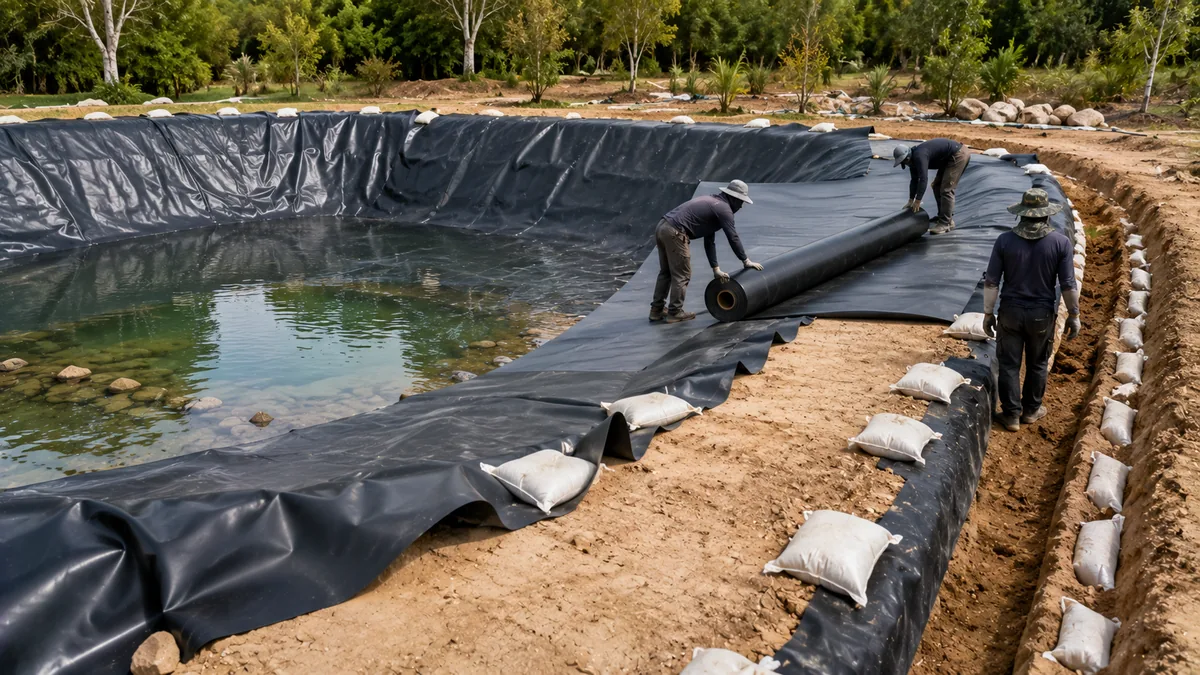
The sheet is the easy part. Everything that decides whether a pond holds water happens before the first roll comes off the truck and after the last seam…
Sheet arrives from the mill consistent and certified. Seams are made on site, in the heat, by people. That is where lining projects succeed or fail.
There are two field welding methods for HDPE geomembrane and they are not alternatives — they do different jobs. A good installation uses a lot of one and as little as possible of the other.
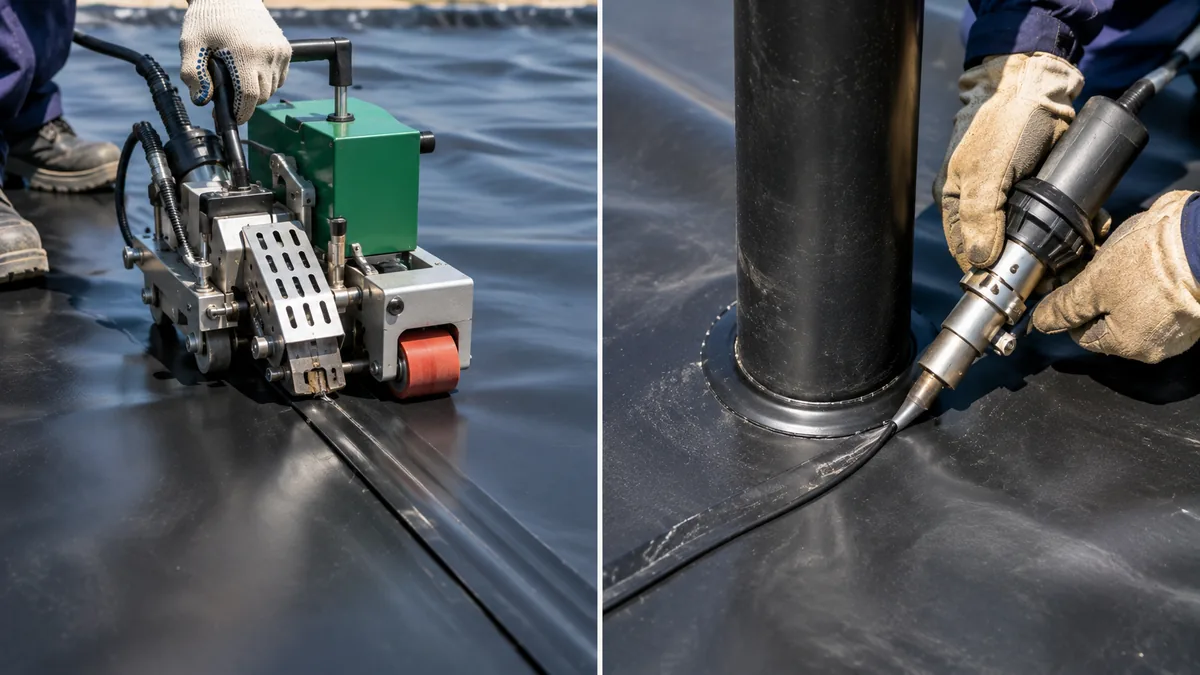
A self-propelled wedge welder is the production tool. Two overlapping panels are drawn over a heated metal wedge that melts the facing surfaces, then immediately pressed together between drive rollers. The machine controls three variables — wedge temperature, speed and roller pressure — and the operator adjusts them through the day as conditions change.
Almost all wedge welders used on lining work are dual-track: they produce two parallel welded tracks with an unwelded channel between them. That channel is the point. Seal both ends, pressurise it, and you have a non-destructive test of the entire seam length in one operation. No other joining method for polyethylene gives you that.
Wedge welding is fast, consistent and comparatively operator-independent. Long straight panel runs on a basin floor progress quickly. It cannot, however, get into corners, around pipes, into sumps, or over an existing patch.
Two pieces of kit matter here and they are often bought together: the extruder itself and a separate hot-air tool for tacking and preheating. A hot air gun supplier in Dubai UAE is the usual source for the latter, and the nozzle range matters more than the headline wattage.
An extrusion welder is essentially a hand-held extruder: it feeds HDPE rod through a heated barrel and lays a bead of molten polymer along a prepared overlap while a hot-air nozzle preheats the surfaces ahead of it. Preparation matters enormously — the surface must be ground clean immediately before welding, because oxidised polyethylene does not bond well.
Extrusion welding handles everything the wedge cannot: patches, T-junctions where three panels meet, pipe boots, sump detailing, terminations at concrete, and every repair. It is slower, far more dependent on operator skill, and it cannot be air-channel tested — which is exactly why a well-planned panel layout minimises the number of extrusion welds a job needs.
Before any production welding, each welder makes a trial weld on offcuts of the same sheet, in the same conditions. Coupons are cut from it and tested on the spot in peel and shear with a field tensiometer. The seam must fail in the parent material rather than at the bond — a peel that separates along the weld is a fail, whatever the number says.
Trial welds are repeated at the start of every shift, after any break of more than an hour, after a machine change, and whenever ambient conditions shift materially. On a site where the temperature climbs 20 degrees between six in the morning and midday, that last condition is not a formality.
| Seam | Test | What it proves |
|---|---|---|
| Dual-track wedge | Air-pressure test of the channel | Continuity along the full seam length |
| Extrusion weld | Vacuum box, or spark test | No through-leak at the point tested |
| Any production seam | Destructive coupon, peel and shear | Bond strength against specification |
| Completed lining | Electrical leak location survey | Pinholes and installation damage anywhere in the sheet |
Destructive testing is exactly what it sounds like: a coupon is cut out of a live seam, pulled, and the hole patched and retested. Specifications set a frequency — commonly one sample per set length of seam. It is the only test that measures actual bond strength rather than absence of a hole.
Heat is as hard on the plant as it is on the crew. Anyone equipping a crew locally rather than importing will find a geomembrane welding machine supplier in Dubai UAE can advise on which units hold their settings through a Gulf afternoon — the specification detail that actually decides seam consistency in July.
Heat changes everything about a welding programme:
The practical answer on hot programmes is early starts or night shifts. It costs more in supervision and lighting and it produces better seams than pushing a crew through an August afternoon.
Every one of these is a process failure rather than a material failure, and every one is caught by testing if the testing is actually done.
Both ends of the air channel in a dual-track wedge seam are sealed, a needle is inserted, and the channel is pressurised to the specified value and held for a set period. If pressure holds within the allowance, the seam is continuous. If it drops, the leak is located and repaired, then retested.
Not for polyethylene. HDPE and LLDPE are joined by fusion — heat, pressure, and time. Adhesives and tapes do not bond reliably to polyethylene and have no place in an engineered lining. PVC is a different chemistry and can be solvent-welded.
Typically in the region of 300–400 °C at the wedge, but the number matters far less than the trial weld result. Correct settings are the ones that produce a coupon failing in the parent material under the day's actual conditions.
Need this specified for a real project? Our crews weld and test every seam on the geomembrane lining projects we deliver in the UAE — send the basin dimensions through the enquiry form and you will get a sheet take-off, a gauge recommendation and a price back.
Wedge and extrusion welding with full seam testing and QC records.
CQA-documented welding to project specification.
The sheet is the easy part. Everything that decides whether a pond holds water happens before the first roll comes off the truck and after the last seam…
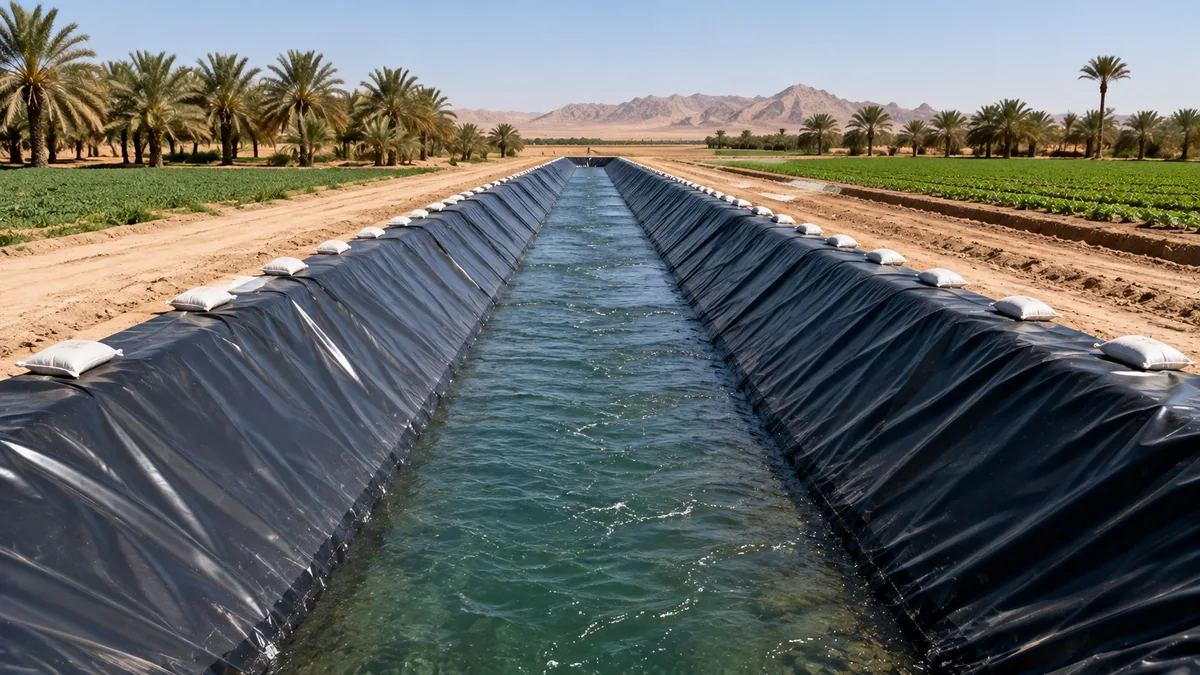
Seepage from an open channel is invisible. There is no leak to point at — just water that arrives at the far end in smaller quantity than it left.
Project enquiry
Tell us the area, the detail count and your programme, and we will price the works properly.