Conveyance & treatment
Canal and lagoon lining
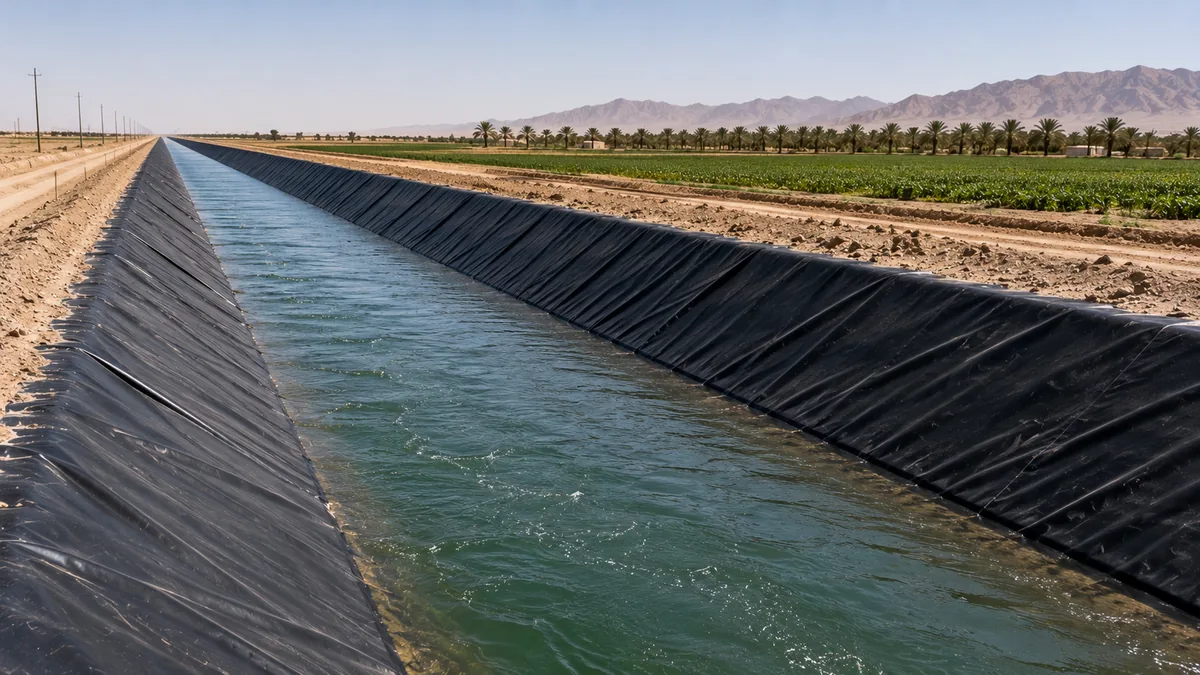
Irrigation canals, stormwater channels, evaporation ponds and wastewater lagoons lined with HDPE geomembrane to stop seepage losses and protect the ground beneath.
Unlined channels lose water everywhere along their length, and the loss is invisible — there is no puddle to point at, just a flow that arrives smaller than it left. On sandy or fissured ground, seepage from an unlined irrigation canal can account for a substantial fraction of everything pumped into it. Lining converts that loss into delivered water.
Canal and channel lining
Channels are lined either with the geomembrane exposed or with the membrane covered by concrete, shotcrete or a soil layer. Exposed lining is cheaper and faster, and it is the right answer where the channel is fenced and the flow carries no abrasive load. Covered lining costs more and is what you want where there is vehicle crossing, grazing animals, heavy debris, or a long design life with public access.
- Geometry: trapezoidal sections with side slopes no steeper than 1V:1.5H for exposed membrane; steeper faces need textured sheet or a covered system.
- Anchoring: a continuous anchor trench along both banks, with intermediate anchoring on long slopes so the membrane cannot creep.
- Structures: the liner is terminated into headwalls, offtakes and division boxes with batten strips and sealant, then extrusion-welded to shape around them.
- Uplift: where groundwater is high, gas and water vents are provided so the membrane cannot be lifted from beneath when the channel is empty. This is the failure mode people forget.
Wastewater and TSE lagoons
Treated sewage effluent storage, balancing lagoons and aeration basins are normally lined with 1.5 mm HDPE over a nonwoven geotextile cushion layer. The gauge is driven by chemical exposure and design life rather than water depth alone, and the detailing is more demanding than a farm pond: aerator supports, inlet and outlet structures, sludge draw-off, and access ramps all pass through the membrane and every one of them is a potential leak path.
Gas is the other consideration. Organic sediments generate gas beneath the liner, and without a venting layer or vent stacks it collects and lifts the membrane into large bubbles that stress the seams. On lagoons carrying organic load we design venting in rather than dealing with it afterwards.
Evaporation ponds
Brine ponds, reject-water ponds from RO plants and process evaporation basins concentrate salts as they work, so the liner sees an increasingly aggressive fluid over its life. These are 2.0 mm applications as a rule, with chemical compatibility confirmed against the actual effluent rather than a generic table, and with freeboard set so that wind-driven waves cannot overtop the anchor trench.
Stormwater channels and diversions
Wadi diversions and site stormwater channels are lined to stop scour and infiltration. Flow velocity is the design driver: above a certain velocity an exposed membrane needs protecting with concrete mattress, geocell infilled with concrete, or rip-rap over a cushion layer, or the first serious rain event will damage it.
Why seepage control pays
Water in this country is either desalinated, pumped from a diminishing aquifer, or trucked. All three have a cost per cubic metre that makes seepage the most expensive way to lose it.
The arithmetic on a lining project is usually a simple one: estimate the loss, price the water, and compare it with the lining cost over the design life. On long conveyance channels the payback period is often measured in a small number of irrigation seasons. We can help put numbers to it if you have flow measurements at each end of the channel.
Questions about this service
Can you line a canal that is in use?
The section being lined has to be dry, but channels are routinely lined in stages so that supply continues through the rest of the system. Tell us the shutdown windows available and we will plan the panels around them.
Exposed liner or concrete over the top?
Exposed is cheaper and faster and works well in fenced channels with clean flow. Concrete or shotcrete over the membrane is worth the extra where there is vehicle crossing, animals, debris or public access. Both use the same welded membrane underneath.
How do you stop the liner floating when the channel is empty?
Vents. Where groundwater can rise beneath the membrane, gas and water relief vents are installed through the liner so pressure equalises instead of lifting the sheet. On sites with high water table this is designed in from the start.
What thickness is used for a sewage lagoon?
1.5 mm HDPE over nonwoven geotextile is the usual answer for TSE and balancing lagoons, moving to 2.0 mm where the effluent is aggressive or the specification demands it. See the thickness guide for how the gauge is chosen.
Project enquiry
Ready to price the job?
Dimensions, depth and what the basin will hold — that is enough to start.