On site
Geomembrane installation and welding
Trained welding crews, hot-wedge and extrusion equipment, and a seam test on every metre of production weld — with the QC record to prove it at handover.
A geomembrane is only as good as its seams and its details. The sheet itself is manufactured to a standard and arrives consistent; everything that decides whether the basin holds happens on site, in heat, wind and dust. Installation is where lining projects are won or lost.
Before the first roll is unwrapped
We inspect and sign off the subgrade. It needs to be graded to the design profile, compacted, and free of stones, roots, sharp gatch and standing water. Side slopes need to match the drawing — a slope built at 1V:2H when the design said 1V:3H changes the sheet specification and the anchoring, and it is better to find that out before the liner goes down.
Anchor trenches are cut around the crest, typically 500 × 500 mm, and penetrations are identified and marked. Where the subgrade is rocky or the head of liquid is significant, a nonwoven cushion geotextile is laid first as a cushion.
Panel deployment
Panels are laid out from the drawing, longest runs first, with seams running down the slope rather than across it so that water and any soil cover cannot work into a seam. Rolls are deployed with a spreader bar, positioned with the correct overlap, and immediately ballasted with sandbags — an unballasted panel in an afternoon shamal will lift, fold and tear, and it will take the crew with it if they are standing on it.
Slack is deliberate. HDPE deployed at seven in the morning at 28 °C will be considerably longer by two in the afternoon at 48 °C. Panels are welded with enough waviness to absorb that movement so the liner does not go into tension and bridge across corners at night.
Welding: wedge and extrusion
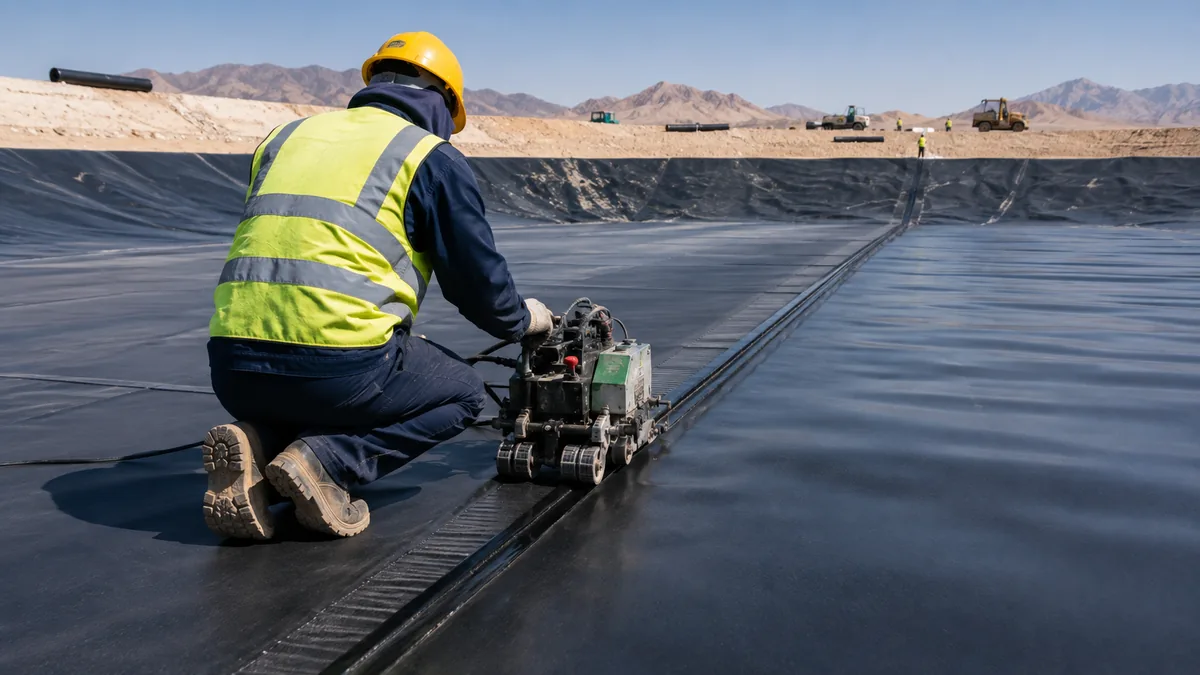
Hot-wedge welding is the production method. A self-propelled machine draws two overlapping panels over a heated wedge and presses them together between rollers, producing a dual-track weld with a sealed air channel down the middle. That channel is what makes the seam testable end to end, which is exactly why the method is specified.
The machines themselves are a trade of their own. If you run your own crew and are sourcing plant rather than a service, a specialist wedge welding machine supplier in Dubai UAE carries the self-propelled dual-track units, and spares and consumables for them are worth lining up before a job rather than during one.
Extrusion welding handles everything a wedge machine cannot reach: patches, T-junctions, pipe boots, sump details, tie-ins to concrete, and repairs. Molten HDPE rod is extruded over a ground and prepared overlap. It is slower, more operator-dependent, and is kept to the minimum a job actually needs.
Hand extruders are consumable-heavy equipment — barrels, nozzles and drive rollers all wear. Crews buying their own usually go through an extrusion welder supplier in Dubai UAE so that rod, spare nozzles and a service route exist locally instead of sitting on a six-week import.
Each welder runs a trial weld at the start of every shift, after every break of more than an hour, and whenever ambient conditions shift materially. The trial coupon is peel- and shear-tested on the spot; production welding does not start until it passes. There is more detail in our guide to hot wedge versus extrusion welding.
Testing every seam
- Air-pressure testing of wedge welds: the air channel is sealed at both ends, pressurised, and held. A pressure drop beyond the allowance means the seam is investigated and repaired.
- Vacuum-box testing of extrusion welds and patches: soapy solution, a clear box, a partial vacuum, and any leak announces itself as bubbles.
- Destructive testing where the specification calls for it: coupons cut at a set frequency and pulled in peel and shear, with the sample locations patched and retested.
- Electrical leak location on projects that warrant it, to find pinholes and installation damage that pressure testing cannot see.
Working in UAE conditions
Summer welding is a scheduling problem as much as a technical one. Surface temperature on a black liner can run 30 °C above ambient, welding settings that were correct at dawn are wrong by mid-morning, and crews need proper heat management. On hot programmes we work early shifts or nights. It costs a little more and it produces better seams than pushing a crew through an August afternoon.
What you get at handover
An as-built panel layout with every panel and seam numbered, the test result for each seam keyed to that drawing, the trial weld records, the operator and machine for each seam, ambient conditions logged, repair locations recorded, and the material certificates for the sheet that went in. If a leak is ever disputed, this file is the difference between a diagnosis and an argument.
How the works run
Site survey and take-off
We measure the basin, check side-slope angles and calculate sheet quantity including overlaps, anchor trench and wastage.
Subgrade preparation
The base is graded, compacted and cleared of stones and roots. Anchor trenches are cut around the crest.
Cushion layer
Where the subgrade is rocky or the head is high, a nonwoven geotextile is laid to protect the membrane from puncture.
Deployment
Rolls are positioned by slope direction, unrolled to the panel layout and temporarily ballasted against wind uplift.
Welding
Panels are joined by hot-wedge dual-track weld; details, patches and pipe boots are finished by extrusion welding.
Testing and handover
Every seam is air-pressure or vacuum-box tested, trenches are backfilled, and you receive the QC log and as-built panel layout.
Questions about this service
Can you install liner we bought elsewhere?
Yes, subject to seeing the material certificates and inspecting the rolls first. We need to know the resin grade and core thickness to set the welders, and we will not warrant seams on sheet whose specification cannot be established.
How is a wedge weld tested?
The dual-track weld leaves a continuous air channel between the two welded tracks. Both ends are sealed, the channel is pressurised with a needle gauge and held for a set period. A stable reading means the seam is continuous along its whole length — which is why this is the only production seam method that can be tested non-destructively end to end.
Do you repair existing liners?
Yes. Repairs are patched with the same grade of sheet, extrusion-welded with rounded corners, and vacuum tested. If the leak location is unknown we can investigate before pricing the repair — searching for a hole and fixing it are two different scopes.
How long does installation take?
Panel area and detail count drive it, not just area. A simple open reservoir with long uninterrupted runs progresses quickly; the same square metreage broken into small basins with dozens of penetrations takes considerably longer, because extrusion welding is slow work.
Do you provide the QC documentation?
Always, on installed works. As-built panel layout, seam register, test results, trial welds and material certificates — issued as one file at handover.
Project enquiry
Ready to price the job?
Dimensions, depth and what the basin will hold — that is enough to start.