Supporting materials
Geotextile and geosynthetics supply
Nonwoven cushion geotextile, drainage geocomposite, geocell and geogrid — the layers that protect a geomembrane and make the system work.
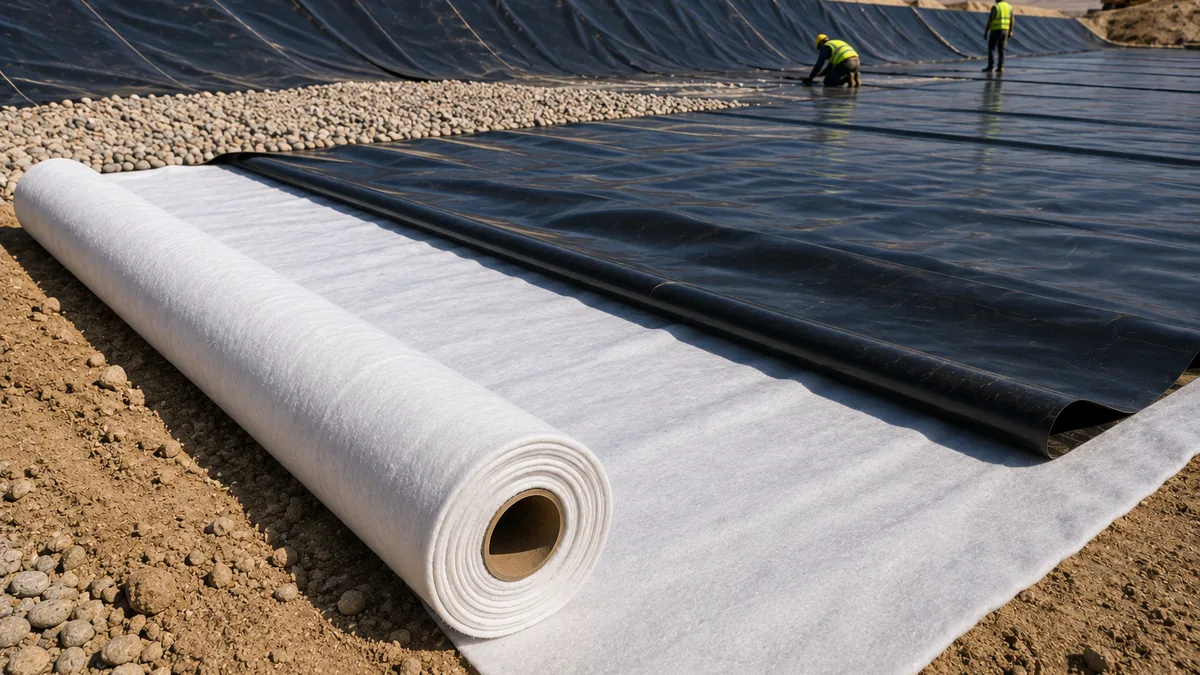
A geomembrane almost never works alone. The sheet is the barrier, but what sits above and below it decides whether the barrier survives installation and stays intact for its design life. Cushion geotextile is the cheapest insurance available on a lining project, and skipping it is the most common false economy we see.
Nonwoven cushion geotextile
Needle-punched nonwoven geotextile is laid between the subgrade and the membrane to absorb the point loads from angular material below. Selection is by mass per unit area, and by the puncture protection that mass delivers under the head of liquid you will actually impose:
| Mass | Typical use |
|---|---|
| 200 g/m² | Separation, light protection on graded sand subgrade |
| 300 g/m² | General cushion layer beneath pond and reservoir liners |
| 400 g/m² | Gatch or gravelly subgrade, deeper basins, above-liner protection |
| 500 g/m² and above | Rock subgrade, landfill protection beneath a drainage stone layer |
Geotextile is used above the membrane as well as below it — a protection layer between the liner and a drainage gravel or a soil cover does exactly the same job in the opposite direction.
Drainage geocomposite
An HDPE drainage core bonded to geotextile on one or both faces, used to collect and convey liquid or gas where there is no room for a gravel layer. It replaces hundreds of millimetres of drainage stone with a few millimetres of manufactured product, which on a lined slope is the difference between a workable design and an unbuildable one. Common in landfill leachate collection, capping gas venting, and behind retaining structures.
Geocell
An expandable honeycomb of HDPE strips, pinned out and filled with soil, aggregate or concrete. On lining projects it does two things: it holds a soil cover on a slope that would otherwise slough, and infilled with concrete it makes a hard protective surface over an exposed membrane in a channel with fast flow. See canal lining for where that applies.
Geogrid and separation
Geogrid reinforces soil in embankments, retaining structures and haul roads — not a barrier product, but part of the same family and frequently ordered on the same project. Woven separation geotextiles under access roads and working platforms keep aggregate out of soft subgrade and reduce the stone thickness needed.
Ordering geosynthetics with your liner
Everything above ships with the geomembrane on the same delivery. It is worth ordering together for a practical reason as much as a commercial one: sequencing. A cushion geotextile that arrives after the liner crew has started deploying panels is a cushion geotextile that does not get installed. Go to HDPE geomembrane liner supply for the sheet itself, or send the whole material schedule through the enquiry form and we will price it as one package.
Questions about this service
Do I always need geotextile under a geomembrane?
No, but you need it more often than most budgets assume. On clean, graded, stone-picked sand a membrane can sit directly on the subgrade. On gatch, rock, reclaimed ground, or under a significant depth of water, a cushion layer is what prevents slow puncture over the years.
What weight of geotextile should I use?
300 g/m² is the general-purpose answer beneath pond and reservoir liners. Go to 400–500 g/m² for rough subgrades, deep basins, or where the membrane is protected from a gravel layer above.
Is geotextile the same as geomembrane?
No. A geotextile is permeable — it is a fabric that filters, separates, protects and drains. A geomembrane is impermeable — it is a barrier. They are almost always used together, and confusing the two on a purchase order is a costly mistake.
Can geotextile be welded to the liner?
Geotextiles are joined by overlapping and sewing, or by spot heat-bonding to hold them in place during installation. They are not welded to the geomembrane; the two layers work independently.
Project enquiry
Ready to price the job?
Dimensions, depth and what the basin will hold — that is enough to start.