Specification
Geomembrane thickness and roll size guide
Every gauge we stock, what it is normally used for, and the arithmetic for turning a basin drawing into a roll count.
Stock thickness range
HDPE geomembrane liner sheet is manufactured from about 0.3 mm up to 3.0 mm. The gauges below cover almost everything specified in the UAE. Anything thinner than 0.5 mm is generally a temporary or agricultural film rather than an engineered liner, and anything above 2.0 mm is specialist work for aggressive chemical containment.
| Thickness | Mil | Roll width | Typical application |
|---|---|---|---|
| 0.50 mm | 20 mil | 7.00 m | Aquaculture ponds, decorative water features, temporary bunds |
| 0.75 mm | 30 mil | 7.00 m | Farm ponds, small irrigation reservoirs, nursery basins |
| 1.00 mm | 40 mil | 7.00 m | Irrigation reservoirs, canal lining, general water storage |
| 1.50 mm | 60 mil | 7.00 m | Wastewater lagoons, landfill base liners, TSE storage |
| 2.00 mm | 80 mil | 7.00 m | Industrial containment, leachate ponds, heavy-traffic subgrades |
| 2.50 – 3.00 mm | 100 – 120 mil | 6.00 – 7.00 m | Aggressive chemical containment and specified heavy-duty works |
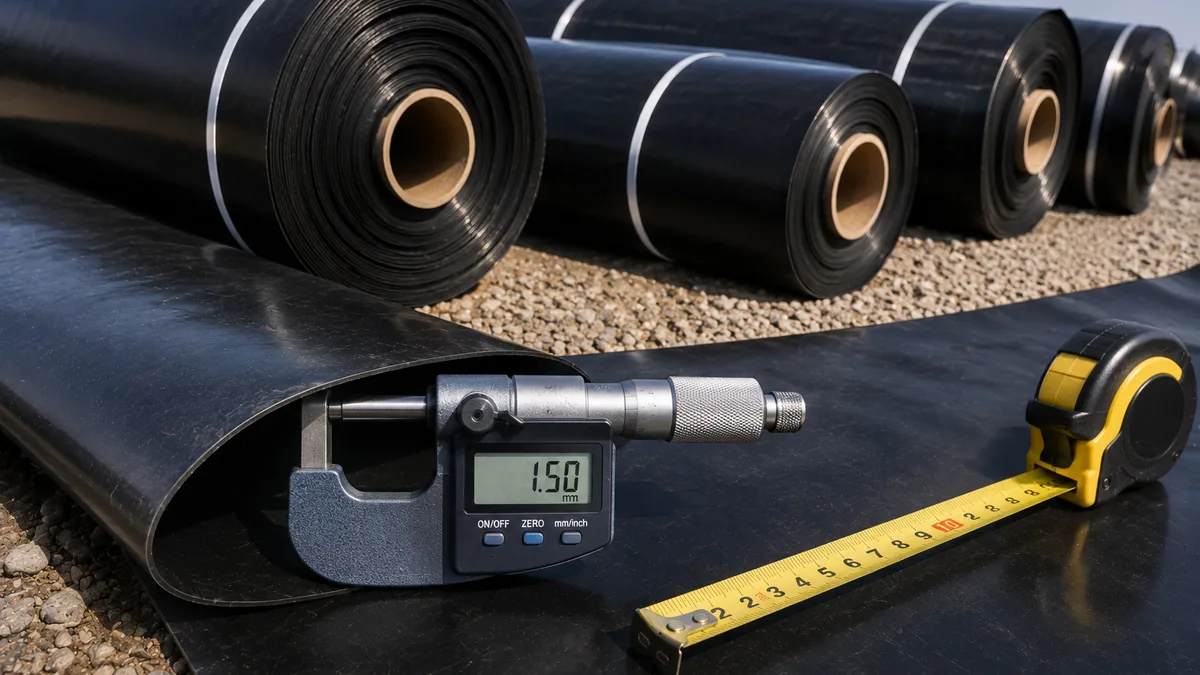
Thickness tolerance is the point most buyers miss. GRI-GM13 allows a small minus tolerance on nominal thickness for smooth sheet, and textured sheet is measured by core thickness rather than over the asperities. Sheet sold as “1.5 mm” that measures 1.35 mm at the core is not the same product, and it will not weld to the same settings. Ask for the mill certificate.
Roll width, length and weight
Seven metres is the standard production width, and it is the number that governs your panel layout: fewer, longer panels mean fewer seams, and fewer seams mean fewer places for a lining to fail. Where a basin is narrower than 7 m, sheet is slit at the mill or trimmed on site.
| Thickness | Width | Length | Area | Approx. weight |
|---|---|---|---|---|
| 0.75 mm | 7.0 m | 175 m | 1,225 m² | ~880 kg |
| 1.00 mm | 7.0 m | 140 m | 980 m² | ~940 kg |
| 1.50 mm | 7.0 m | 105 m | 735 m² | ~1,060 kg |
| 2.00 mm | 7.0 m | 80 m | 560 m² | ~1,080 kg |
Weights are calculated at a nominal HDPE density of 0.94 g/cm³ and vary with texture and mill. Confirm lifting weights before booking plant.
Choosing a thickness
Four questions decide the gauge:
- How deep is the liquid? Head pressure drives the sheet into every irregularity in the subgrade. Deeper basins need thicker sheet or a heavier cushion geotextile beneath.
- Is the liner exposed? Exposed sheet takes UV, daily thermal cycling and wind uplift. 1.5 mm is the practical minimum for a permanently exposed liner in Gulf conditions; 1.0 mm is acceptable if it will be covered with soil or permanently submerged.
- What is the subgrade? Sand that has been graded and rolled is kind to a liner. Gatch, crushed rock or reclaimed ground is not, and either the gauge goes up or a cushion geotextile goes in.
- What goes in it? Water, TSE, brine, leachate and process chemicals all load the membrane differently. Chemical containment is normally 2.0 mm and needs a compatibility check against the specific fluid.
Working out how much sheet to order
Take the wetted area of the basin — floor plus the sloping sides measured along the slope, not in plan — then add:
- Seam overlap: about 100 mm per wedge weld. Across a large basin this is a measurable percentage, not a rounding error.
- Anchor trench: the sheet must run over the crest, down into the trench and along its base. A 500 × 500 mm trench consumes roughly 1.5 m of sheet width around the entire perimeter.
- Slack for thermal movement: HDPE expands and contracts noticeably between a 20 °C night and a 55 °C afternoon. Panels are deployed with deliberate slack, and that slack is sheet.
- Wastage: allow 5–10 per cent depending on how irregular the shape is and how many penetrations there are.
A rectangular basin 50 m × 30 m × 3 m deep with 1V:3H side slopes works out at roughly 2,200 m² of wetted area, and about 2,600 m² of sheet once trench, overlaps and wastage are included. Send us the dimensions and we will do this properly against your drawing.
Thickness and size questions
What are the standard geomembrane roll sizes?
HDPE geomembrane is normally produced 7 m wide. Roll length depends on gauge because the roll has to stay liftable: about 140 m for 1.0 mm, 105 m for 1.5 mm and 70–90 m for 2.0 mm. That puts a full roll somewhere between 900 and 1,400 kg, which is a telehandler lift, not a manual one.
What are the specifications for geomembranes?
The reference document for HDPE sheet is GRI-GM13, which sets minimum values for density, thickness, carbon black content and dispersion, tensile properties at yield and break, tear and puncture resistance, stress crack resistance and oxidative induction time. LLDPE sheet is covered by GRI-GM17. Individual properties are measured by ASTM methods — D5199 for thickness, D6693 for tensile, D4833 for puncture, D1004 for tear.
How many square metres are in a roll?
Multiply width by length: a 7 m × 140 m roll is 980 m², and a 7 m × 105 m roll is 735 m². Order more than the basin area — allow for overlaps at every seam, the run-up into the anchor trench, and the extra sheet the side slopes consume.
How do I convert mm to mil?
One mil is one thousandth of an inch, which is 0.0254 mm. So 1.0 mm is roughly 40 mil, 1.5 mm is 60 mil and 2.0 mm is 80 mil. American specifications quote mil, Gulf and European specifications quote millimetres, and Chinese mills sometimes quote microns — 1,000 microns being 1 mm.
Should I use smooth or textured sheet?
Smooth sheet on the floor and on shallow slopes. Textured sheet once the slope is steeper than about 1V:3H, or wherever soil cover has to sit on the membrane without creeping down the face. Single-textured sheet is used when only one side needs friction; double-textured when the liner is sandwiched between two soil layers.
Project enquiry
Not sure which gauge the job needs?
Tell us the depth, the fluid and whether the sheet stays exposed. We will specify it and price it.