Water containment
Pond liner supply and installation
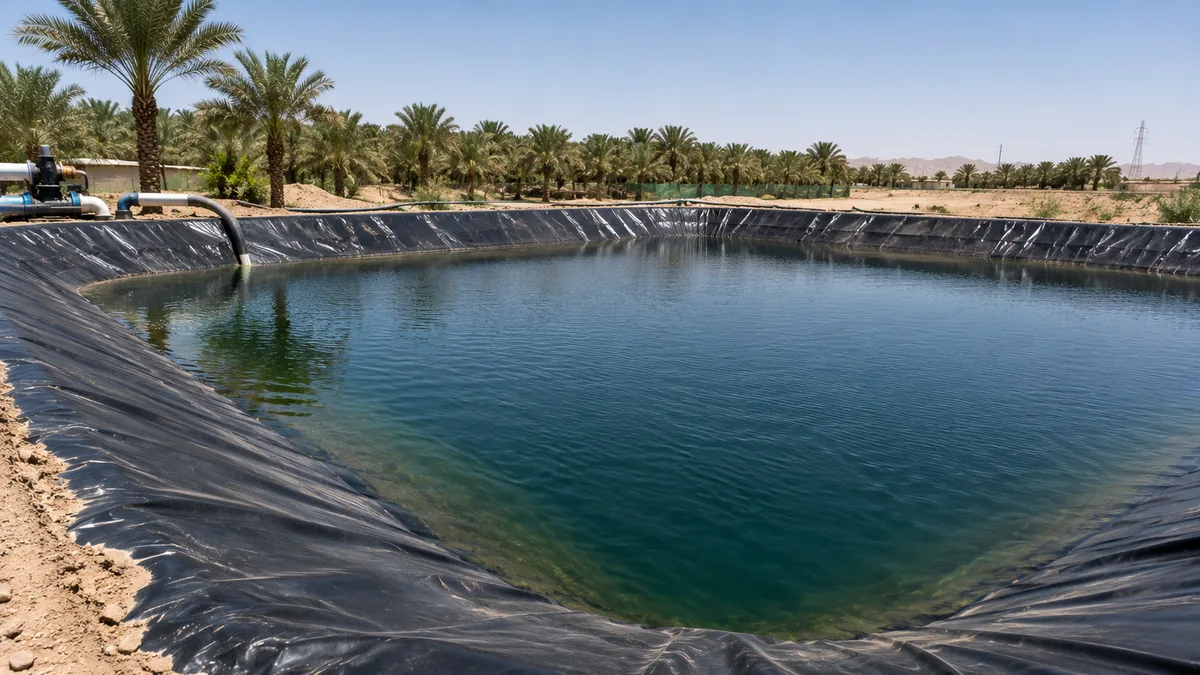
HDPE and LLDPE pond liner sheet for farm ponds, aquaculture basins, landscape lakes and nursery reservoirs — welded continuous so there is nothing to seep through.
A pond in the UAE loses water two ways: down through the ground and up into the air. A liner deals with the first completely, and it is the cheapest intervention available — lining an existing leaking basin usually pays for itself in water cost long before anything else on a farm does.
Which sheet for which pond
| Pond type | Thickness | Notes |
|---|---|---|
| Decorative / landscape pond | 0.50–0.75 mm | Usually covered with gravel or a concrete edge detail; appearance matters at the waterline |
| Aquaculture / fish pond | 0.75–1.00 mm | Smooth sheet, rounded corners, protected inlet, no exposed weld beads where nets are dragged |
| Farm irrigation pond | 1.00–1.50 mm | Exposed sheet, higher head, plant traffic at the crest during filling and cleaning |
| Effluent or slurry pond | 1.50–2.00 mm | Chemical loading, gas generation, and a specification to satisfy |
Where the ground is soft, reclaimed, or likely to settle unevenly, LLDPE is worth considering instead of HDPE. It is less rigid and stretches much further before it fails, which matters in a small basin with tight corners where an HDPE sheet would want to bridge rather than conform.
The details that decide whether a pond holds
- Anchor trench. The liner runs over the crest, into a trench and gets backfilled. Without one the sheet lifts on the first windy day and pulls off the slope.
- Inlet and outlet. Pipe penetrations get a fabricated HDPE boot, extrusion-welded to the liner and clamped to the pipe. This is the most common leak point on farm ponds, and it is entirely avoidable.
- Overflow. A basin without a designed overflow will eventually overtop, and water running over an unprotected crest scours out the anchor trench.
- Corners. Sharp internal corners force complex extrusion detailing. Rounding them at the earthworks stage is free and makes the lining far more reliable.
- Access for cleaning. If a tractor or a pump will go into the basin, the liner needs protection at that point — a concrete ramp or a sacrificial cover layer.
Existing ponds that leak
Retro-lining a leaking pond is routine. The basin is drained and dried, the base regraded, and the new membrane installed over the old surface with a cushion geotextile between if the old lining is brittle or the base is stony. Where the original liner is a thin agricultural film, it is normally better to remove it than to line over it, because trapped water and gas beneath a new liner will lift it into whale-shaped bubbles.
Evaporation, and what to do about it
A lined basin stops seepage but does nothing about evaporation, which in this climate is substantial through the summer. Options are floating covers, floating shade balls or a shade structure, depending on how the water is used and how much the loss is costing you. We can quote a floating cover with the lining if evaporation is the bigger part of your problem — see also reservoir and tank lining.
Fish and plants
HDPE and LLDPE geomembranes are inert. They do not leach plasticisers, which is one reason PVC and unsuitable recycled films are a poor choice for a stocked pond. For aquaculture we use smooth sheet, keep extrusion beads out of areas where nets are dragged, and make sure the liner is properly ballasted or anchored so it cannot float when the pond is drawn down.
Questions about this service
What is the difference between a geomembrane and a pond liner?
“Pond liner” is the application; “geomembrane” is the material class. Most engineered pond liners are HDPE or LLDPE geomembranes. The practical difference is between a thin film sold by the metre for a garden feature and a welded geomembrane specified to hold water for decades.
Can pond liner be joined on site?
Yes — and it should be. Panels are heat-welded into one continuous membrane. Overlapping sheet without welding, or joining with tape or adhesive, will leak. Any basin bigger than a single 7 m roll width needs welded seams.
Is HDPE pond liner safe for fish?
HDPE is inert and does not leach into the water, which is why it is used for aquaculture worldwide. New sheet should be rinsed and the pond filled and circulated before stocking, as with any new installation.
How much liner do I need for my pond?
Measure the floor plus the sloping sides along the slope, then add for seam overlaps, the anchor trench and wastage. The roll size guide shows the arithmetic, or send us the dimensions and we will do the take-off.
Do you line existing concrete ponds?
Yes. Concrete basins that have cracked are frequently lined with HDPE rather than repaired. The membrane is anchored into a batten strip fixed to the wall, with the corners and any penetrations detailed by extrusion weld.
Project enquiry
Ready to price the job?
Dimensions, depth and what the basin will hold — that is enough to start.