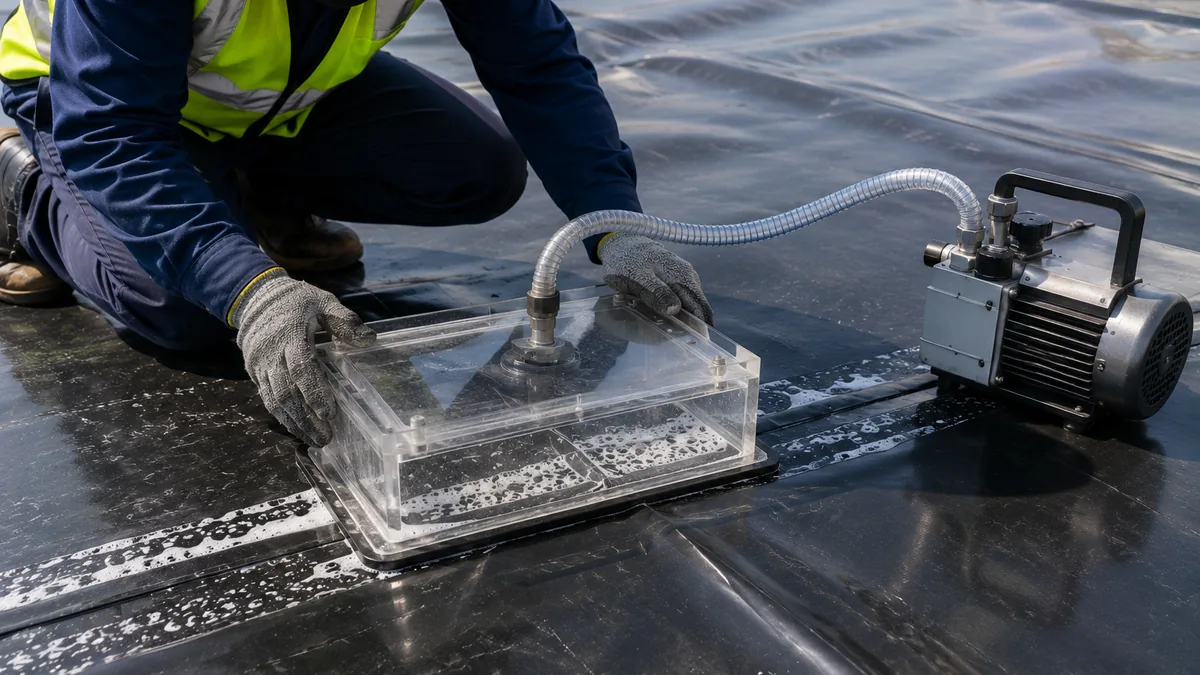
Quality control
Finding leaks: seam testing and leak location surveys
Most liner leaks are not seam failures. They are punctures made after the seams passed — which is why the testing regime has more than one method in it.
Buried liner is a decades-long asset almost anywhere. Exposed liner in a Gulf summer is a much more interesting question, and the answer depends on things you can control.
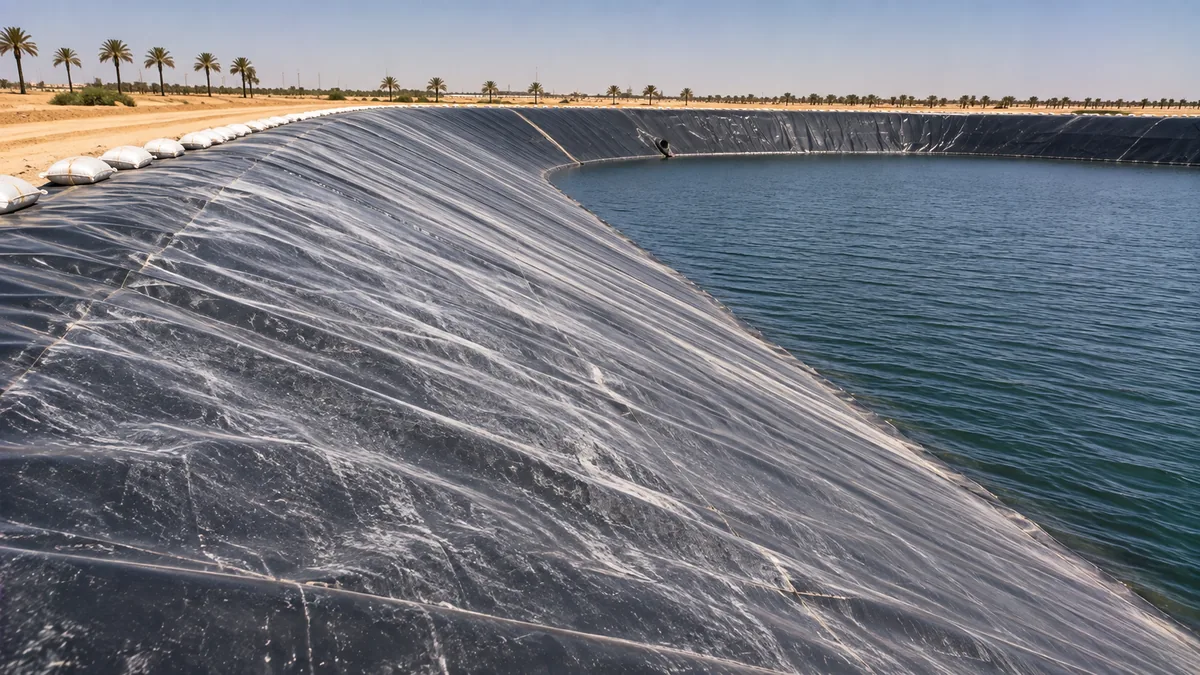
Geomembrane does not wear out the way a mechanical component does. It degrades chemically, slowly, and mostly invisibly — and then it becomes brittle and cracks. Understanding the mechanism tells you which decisions actually affect service life.
HDPE degradation proceeds in three stages:
Because stage one dominates, the practical question is: how fast is this liner spending its antioxidants?
Surface chalking, a dull grey cast replacing the original black, and micro-cracking visible when a piece is flexed. The reliable indicator is behavioural rather than visual: a liner that is starting to crack at anchor points, corners and old wrinkles — the places where stress concentrates — while panels remain intact is a liner in stage three.
If a lining matters and it is more than fifteen years old, a coupon can be cut and laboratory tested for remaining oxidative induction time. That is a measurement rather than a guess, and it tells you whether to plan replacement.
A buried or permanently submerged HDPE liner, properly specified and installed, is a multi-decade asset and is generally not the thing that limits the life of the structure it sits in.
An exposed liner in Gulf conditions is the harder case. A 1.5 mm GRI-GM13 sheet, installed with slack, with a cushion layer beneath it and a basin that is usually holding water, is reasonably expected to serve well beyond twenty years. The same sheet installed drum-tight over stones in a basin that sits empty every summer will not.
Almost every liner failure we are called to look at is premature, and almost none of them are the sheet simply reaching the end of its chemistry. They are punctures from missing cushion layers, cracks at over-tensioned anchor details, and leaks at pipe penetrations that were never properly detailed.
Slowly, and only after the built-in antioxidant package has been consumed. Carbon black screens UV and the stabilisers absorb what gets through; once those are exhausted, the polymer oxidises and eventually becomes brittle.
Keep the basin holding water, specify a certified sheet at an adequate gauge, install with slack rather than under tension, use a cushion layer beneath, and consider white-surfaced sheet if the basin is often empty in summer.
Yes. A coupon can be cut and laboratory tested for remaining oxidative induction time along with tensile properties. It converts a guess about remaining life into a measurement, and the sample location is patched and retested afterwards.
Need this specified for a real project? We specify sheet for the conditions it will actually see, and supply HDPE liner sheet nationwide — send the basin dimensions through the enquiry form and you will get a sheet take-off, a gauge recommendation and a price back.
Certified sheet with the additive package the exposure demands.
Deployed with slack, anchored properly, tested throughout.
Most liner leaks are not seam failures. They are punctures made after the seams passed — which is why the testing regime has more than one method in it.
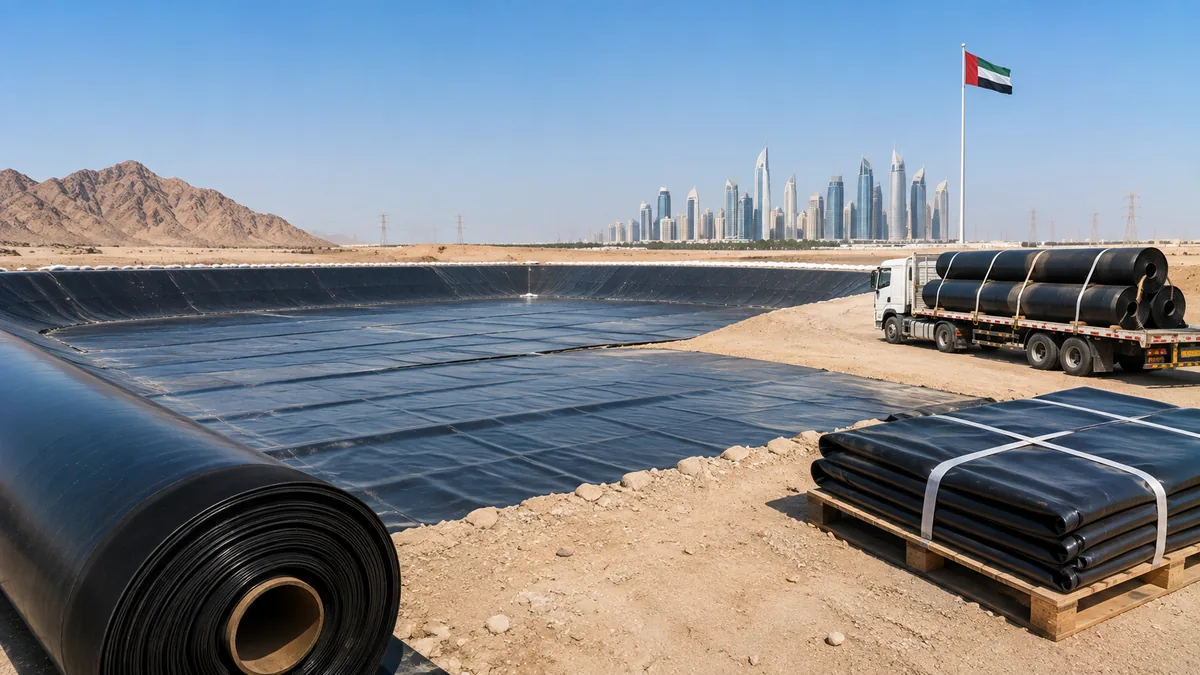
The country is small enough that one stockholding serves all of it, and varied enough that the lining job in Ras Al Khaimah is nothing like the one in Al…
Project enquiry
Describe what you are seeing and how old the lining is. We will tell you whether it needs testing or replacing.